
Showing posts with label volunteers. Show all posts
Showing posts with label volunteers. Show all posts
Friday, September 19, 2014
The Blog has Moved!
Significant progress was made in the past year to improve and to extend the Institute’s electronic footprint. The next step is to consolidate all of our communications on one platform. Thus, as of this blog all future blogs will be found at the CIG website (www.cig-icg.gr) under the heading “Blog”, no less!
We will retain the address cig-icg.blogspot.gr as the Archive of the CIG Blog which started in January, 2011 through today’s “final” blog. The link on this blog will take you to the CIG website.
In the new location I look forward to continue sharing with our readers and supporters news relating to the Institute, announcements of lectures/events at CIG and in Athens, comments on archaeological topics relating to Greece, guest blogs from our fieldwork projects and images from the Frederick Winter B/W Negative Collection.
Cordially,
David Rupp
Director


Friday, May 30, 2014
Last Chance!!!

This exhibit of mixed media, photography and fine art “in collision” has the provocative title “Αντίο κι ευχαριστώ για τα ψάρια”. This is a look back at how Greece has influenced Chris’ art. The show is a tribute to this country where he has lived, and where he has fed off of the inspiration that is found everywhere. Greece is a country that has inspired him, both directly and indirectly, to create art of which he is very proud. This collection examines living all of the seasons in Athens, learning from the people and the environment, and simply being in Greece. The media used bump up against each other in a way that he believes is the very attitude one can find in Greece: the old, new, and even the future coming together. To the people of Greece Chris can only say “Ευχαριστώ!”. Here’s an opportunity to contemplate Chris’ take on Greece and to wish him and Allison a fond farewell. We look forward to seeing you!

With this exhibition the activities of the Institute will stop until the Fall. The Office and Library will remain open through July 31st. More about that later, as the summer has yet to begin!
Cordially,
David Rupp
Director
Friday, October 25, 2013
The Institute’s "Portal to the Past" is Coming to a Computer Near You, Very Soon!!!


Cordially,
David Rupp
Director
Friday, August 30, 2013
Aerial Excavation
Over the last week I spent some time on my very first archaeological excavation. You'd think doing volunteer work for the CIG would be all about going out in the field regularly, always getting my hands dirty. Unfortunately since I’m their IT/Communications specialist, all of my work is done at home or at the CIG library. However when I was given the opportunity to head out on the dig at Kastro Kallithea, if only for a week, I jumped at the chance.
 For the most part my role on the dig was that of labourer, working on backfilling a site, but I did have a unique opportunity to do something dealing with my interest in photography. The project was doing aerial photography of several features, and fortunately I came to the site as this photography work was in full swing. While I’ve photographed many different objects using many different methods, this is a form of photography I'd never experienced. Dr. Margriet Haagsma, the leader of this excavation asked me if I'd be interested in helping her photograph several features of the site using an aerial photography rig she discovered on the internet. I can’t tell you how thrilled I was at the chance to learn about this form of photography.
 I’ve learned that there are several companies in Greece that can shoot aerial photographs professionally, however many of them are very expensive, and did not fit the budget for this particular dig. Dr. Haagsma did some research and came across the website www.publiclab.org that sold an inexpensive balloon photography kit that allows anybody to become an aerial photographer for about one hundred dollars. The intended purpose of their kits is to allow anybody to map their own environment, without relying on government or corporations. For Dr Haagsma it was perfect for her research, and well within her budget.
 There was a little bit of custom work done to the original plans provided in the kit, most notably an extra line was added for more control. The rig is very simple, and other than a plastic bottle (used for the body of the rig), the helium, and the extra string for the guideline, all is provided with the kit. The kit does not come with a digital camera, however most standard cameras work perfectly well. The project used a Nikon Coolpix P330, 12.2 Megapixels.
 Early in the morning it looked as though the weather gods were smiling upon us with a fairly still day. After filling the balloon, we were ready to go. It is a little challenging to control the balloon when the wind picks up even a little, but for the most part it was very smooth. You have to set the camera to shoot continually (in our case: one photo every 30 seconds) and you don't really know if your shots are successful until you bring the camera back down. However the results were fantastic, and after an hour or so at each site we shot many great pictures perfect for Dr. Haagsma 's needs.
 You could improve this rig with a bigger camera set up, and with a long distance remote, however if your camera gear becomes too heavy and it would require more (or bigger) balloons to get any altitude. You would also run the risk of damaging an expensive camera should the balloon(s) fail. I think that the best bet is either to use an inexpensive camera that you wouldn’t miss if there was a mishap, or consider purchasing a very sturdy camera designed for rough and tumble play (such as a go pro camera). With the advancements in inexpensive digital cameras, using anything more high tech really isn't necessary at all.
 On a side note, I'd like to thank Dr Haagsma and her whole team for making me feel welcome, showing me a real dig experience, and even teaching me a thing or two about the history of Kastro Kallithea. Although I'm sore from a great deal of digging and lifting, it was truly an experience I will not forget.
Chris Stewart


Chris Stewart
Thursday, August 1, 2013
Kalo Mina!
It is that time of year! As of today we are closed for the Institute’s annual August recess. On Tuesday, September 3rd we re-open at 9:00 am for the 2013/14 academic year.
 |
| View from Palaikastro, Crete |
 |
| Old house at Monastiraki, Ierapetra |
Enjoy the hot Greek summer where ever you find it! See you in September…………….
Kalo Kalokairi!
David Rupp
Director
Friday, December 2, 2011
An Art Exhibition Opening plus the new Canadian Ambassador in Person and G.I.S.ing Boeotian Landscapes
 |
| "Sad Lawyer" by Chris Stewart |
 |
| HE Robert Peck with longtime CIG supporter Ian Vorres |
With all of these exciting extras, do not fear that the traditional elements of this gathering will be forgotten! Yes, Virginia, Jonathan’s mulled wine and ample amounts of kourambiedes and melomakarona will be there too. So please join us for good companionship and cheer, to put aside for a moment the bleak financial situation that has engulfed us.

With John Fossey’s generous donation of books and monographs to the Library earlier this year, many of them related to his long-standing research interests in Boeotia, we added Boeotian Studies as one of the areas of specialization for the Library. To augment that collection, one of our most recent purchases focuses not simply on Boeotia but also on GIS-based analyses, another one of the Library’s specialties.
The volume in question is by Emeri Farinetti and it is entitled, Boeotian Landscapes. A GIS-based study for the reconstruction and interpretation of the archaeological datasets of ancient Boeotia (BAR International Series 2195, Oxford, 2011). Dr. Farinetti has turned her doctoral dissertation for the University of Leiden, under the supervision of Prof. John Bintliff, into a stimulating exploration of how GIS can serve both as a platform for storing and organizing geographical based datasets and the analysis, reconstruction and interpretation of them. For those not familiar with the purpose, the potential and the power of using GIS to examine settlement patterns and resource exploitation at the regional level Chapter I and Concluding Remarks is an excellent way to start. Chapter II.1-2 presents succinctly the physical landscape of Boeotia and the state of archaeological research there. It should be added here that this region has been surveyed in the past twenty years by a number of sophisticated pedestrian surveys, including CIG’s Eastern Boeotia Archaeological Project. Using the concept of chora or the territory of an ancient polis the remainder of the chapter is divided into 14 separate sub-regions, most corresponding to ancient poleis. The topographical setting, boundaries, physical land units, resources and the archaeological record of each are summarized with ample maps, tables and graphs. Of particular interest is the relationship of known archaeological and historical sites to the modern road network as a discovery factor. She then proceeds to analyzing these datasets in terms of settlements, burial areas, cult places/religious areas, forts and fortifications and other unspecified activities. For each territory she has created a multicolored classified surface map representing the cost-weighted distances (30 minutes and longer walking ranges) for the known 1st and 2nd order settlements from the Geometric through Ottoman periods.
In Chapter II.4 Farinetti pulls together all of these disparate analyses of the landscape as viewed from a revised settlement chamber (or chora) approach, the German Landeskunde tradition, the Community area theory and the taskscape concept. Here she discusses the settlement patterns of ancient Boeotia from the perspective of the 1st order settlements, most of which were the location of a polis and settlement over as long period. The second order settlements, towns and larger villages, were occupied for shorter periods. Again these presentations come with ample maps, charts, and tables subdivided by chronological periods and themes. Appendix I, organized by the 14 sub-regions, contains summaries of the archaeological evidence on which her analyses are based. A CD-ROM contains two more appendices – one (II) with the geographical sub-regions of Boeotia and the other (III) is a list of units of archaeological evidence. The Bibliography is extensive and up-to-date.
Such an approach could and should be used for the other regions of the Aegean basin. Our Library has more GIS-based case studies from the Mediterranean basin as well as the methods of archaeological survey and the results for perusal.
Cordially,
David Rupp
Director
Friday, October 21, 2011
Welcome Ambassador Robert Peck and Congratulations Laura Surtees!!!

After meeting our Neda and Franz Leipen Fellow, Chris Wallace, our Wilfrid Laurier University Intern, Haley MacEachern, and our volunteer, Chris Stewart, we discussed over coffee the present state of affairs and the long-term aspirations of the Institute. It is clear that Ambassador is a man of ideas and energy and seeks to find productive synergies between CIG and the Embassy. We look forward to working with him and his able staff in making Canada and the Institute more prominent in Athens and in Greece. He was given the full tour of the Library, the Offices and the Hostel. When he was last stationed in Athens all of these components were situated in a single apartment on the third floor. We’ve come a long way, baby, eh?!
Welcome Ambassador Peck!!!

The Institute through its undergraduate internships and its graduate fellowships provide hands-on practical learning experiences for young Canadians aspiring to an academic career. In addition, they have ample opportunities to learn more about Greece – ancient and modern – and to meet others like them at the other Foreign Archaeological Schools and Institutes who are on the long road that forms a life’s work.
In 2001/2 Laura Surtees was a Canadian Museums Association Intern at the Canadian Institute through the Youth International Internship program funded by the Canadian government. Laura’s star continues to rise as a Ph.D. candidate in Archaeology at Bryn Mawr College. On Tuesday she was officially awarded one of the three, prestigious Whiting Fellowships at Bryn Mawr for this academic year. These are given by the Mrs Giles Whiting Foundation. This Fellowship will enable her to finish in 2012 her doctoral dissertation, which is entitled, "A Thessalian City: The Urban Survey of Kastro Kallithea". Congratulations Laura!!! Bravo sou!!!
Cordially,
David W. Rupp
Director
Friday, June 10, 2011
The Fred Winter Photo Project Continues


Although the photos of the many archeological sites are impressive, I found myself drawn to the more personal photos. The negative above was noted as "the men who arrested me".

This photo is of the "man who gave us figs". Both of these pictures where taken in 1957 and they tell a story of not only the archaeology but of adventure that went into exploring the sites at that time. As I continue to sort through Professor Winter's collection of photographs I'll be keeping an eye out for these personal gems that examine not only ancient history, but the recent history of Greece.
Chris
Wednesday, March 30, 2011
Chris Stewart, CIG Volunteer
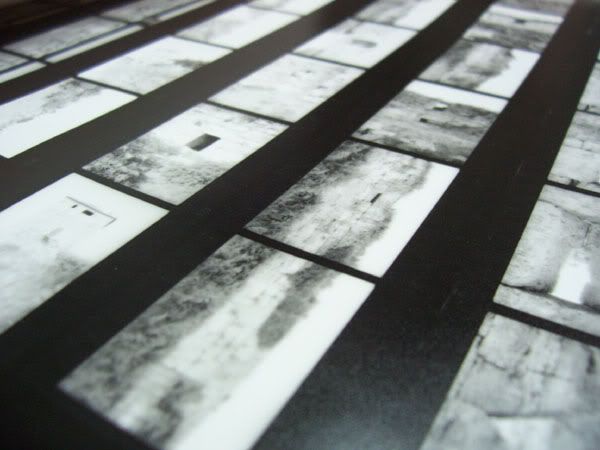 |
| Contact sheet from photo collection of Professor Fred Winter CIG-ICG |
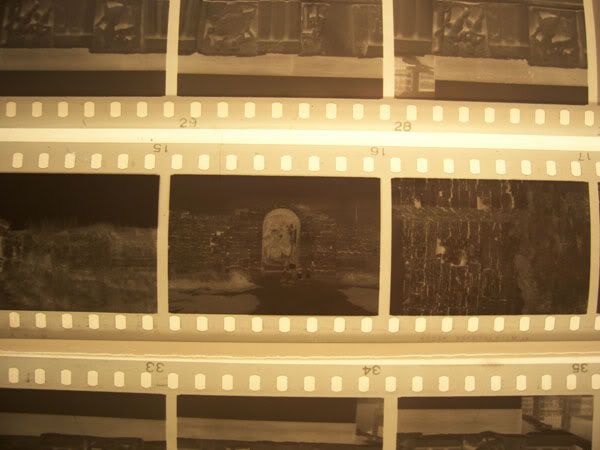 |
| Negatives from photo collection of Professor Fred Winter CIG-ICG |
Chris
Subscribe to:
Posts (Atom)